
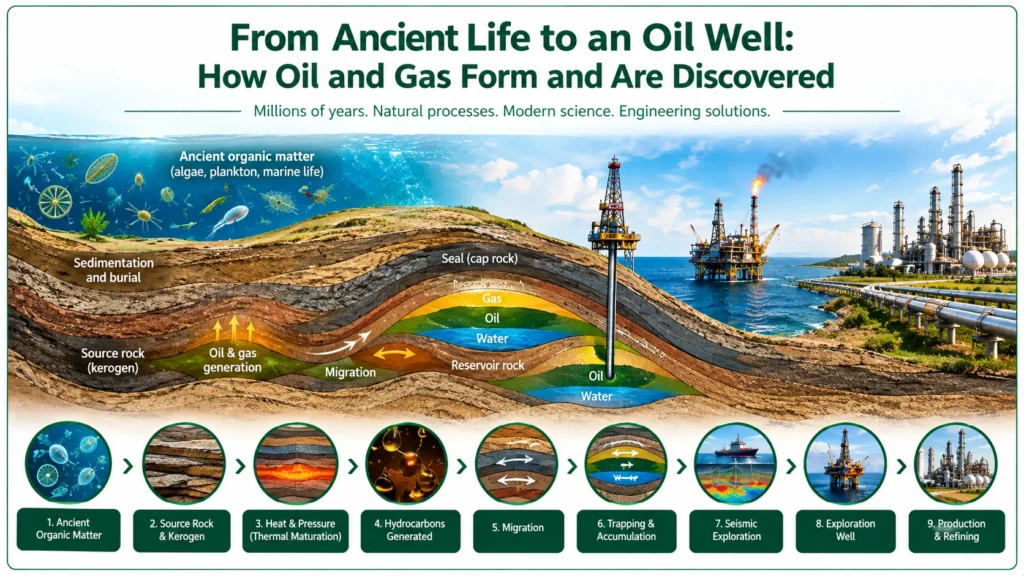
Crude oil and natural gas do not normally exist as giant underground lakes waiting to be pumped out. Instead, hydrocarbons can occupy tiny pore spaces within rocks, much like water occupying the spaces within a sponge.
But how did these hydrocarbons get there?
The answer begins millions of years ago, when organic material was deposited in ancient environments. Over long spans of geological time, deep burial, intense heat and pressure, and chemical reactions turned organic debris into hydrocarbons.
Finding those hydrocarbons is another challenge altogether. To find oil and gas, geoscientists and engineers analyze subsurface rock formations, map potential petroleum systems, process seismic images, and drill exploratory wells to confirm their predictions.
This article follows that journey—from ancient organic matter to the exploration well.
Table of Contents
The Transformation Journey: Ancient Organic Matter to Usable Oil & Gas
One common misconception is that crude oil comes mainly from dinosaurs.
It doesn’t.
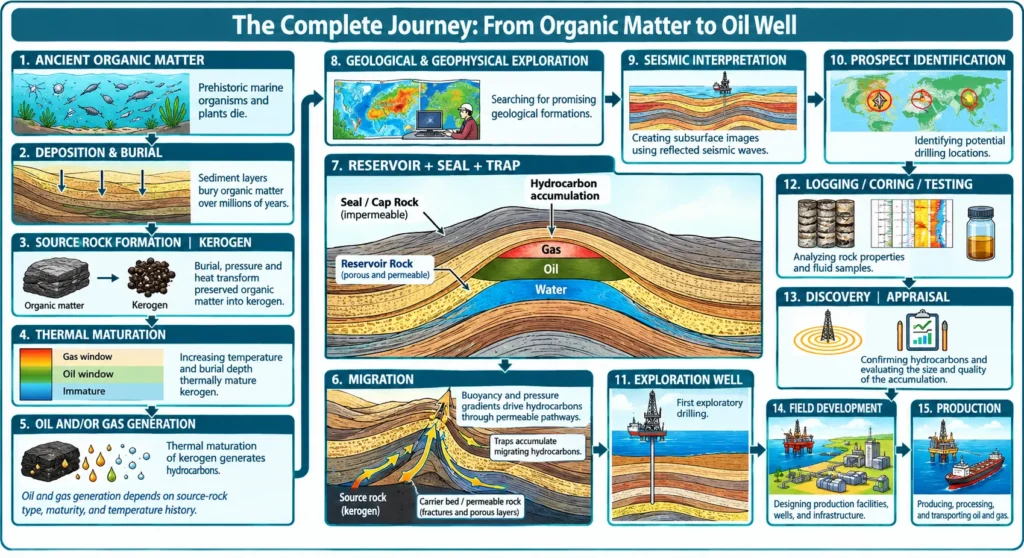
Petroleum is generally associated with ancient organic matter, including microscopic organisms such as algae and plankton, as well as other aquatic and terrestrial organic material. Under suitable geological conditions, this organic matter can eventually become kerogen, a solid form of organic matter found in sedimentary rocks. With sufficient burial, temperature, pressure, and time, kerogen can generate oil and natural gas.
The process takes millions of years.
A simplified sequence looks like this:
Organic matter → Burial → Kerogen → Thermal maturation → Oil and/or gas → Migration → Accumulation
Let’s look at each stage.
How Does Organic Matter Become Petroleum?
1. Organic Matter Is Deposited
Plants, algae, plankton, and other organisms live, grow, and eventually die.
In some environments, their remains become mixed with fine sediments such as mud and clay. When low-oxygen conditions protect organic matter from decaying completely, it becomes buried and trapped within sediment layers.
Over time, more sediment accumulates above it.
2. Burial Continues
As additional layers of sediment are deposited, the older material becomes buried deeper underground.
As layers of sediment build up, the older deposits become buried more deeply. The increasing weight of the overlying material raises the pressure, while temperature generally rises with depth. These changing conditions influence how the preserved organic matter transforms over geological time.
The original organic material gradually changes as burial continues.
This early stage of transformation creates kerogen as a key byproduct.
Kerogen is not crude oil itself. It is a solid organic material within sedimentary rock that can generate oil and natural gas when subjected to appropriate geological conditions.
3. Thermal Maturation Takes Place
As the source rock becomes deeper and hotter, chemical reactions change the kerogen.
Depending on the type of organic matter and its thermal maturity, the source rock may generate predominantly oil, gas, or different mixtures of hydrocarbons.
This is often explained using the terms:
- Oil window
- Gas window
These terms are useful for understanding the concept, but the temperature boundaries are not universal fixed numbers. Actual hydrocarbon generation depends on factors such as kerogen type, burial history, heating rate, pressure, and geological time.
Rather than viewing oil and gas formation temperatures as fixed cutoffs, it is more accurate to understand them as broader thermal maturity zones.
A Simple View of Petroleum Formation
You can visualize the process like this:
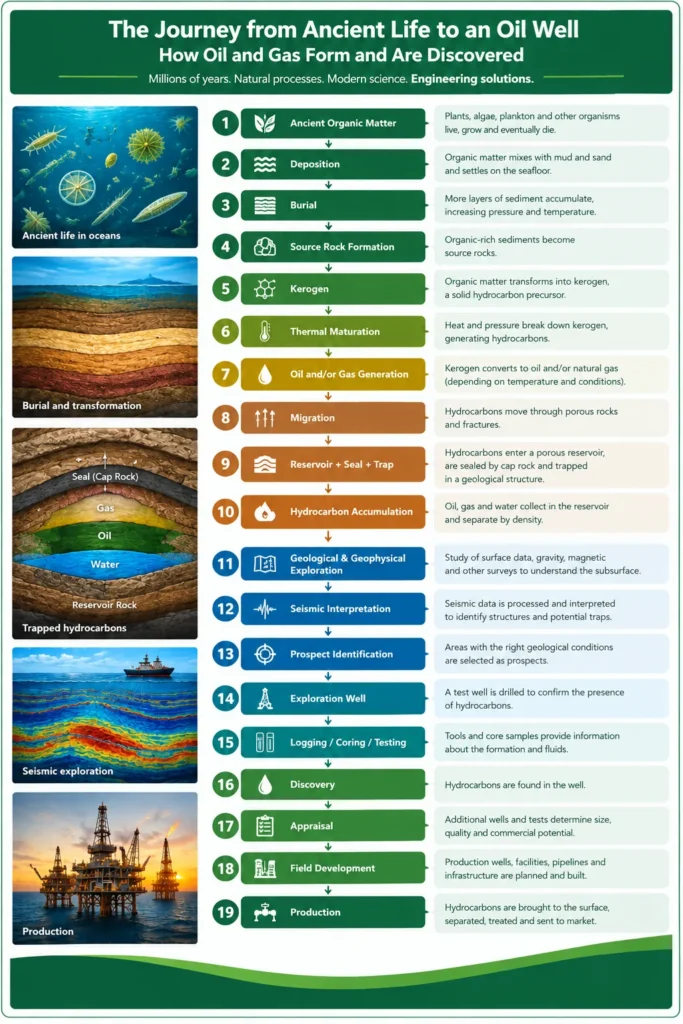
This is a simplified representation. Real petroleum systems can be considerably more complex.
What Is a Petroleum System?
Finding oil or gas requires more than a single promising rock layer; it takes a precise combination of multiple underground conditions to create a working petroleum system.
The core elements commonly considered are:
| Element | What It Does | Examples |
|---|---|---|
| Source Rock | Generates hydrocarbons from organic matter | Organic-rich shale, mudstone |
| Migration Pathway | Provides a route for hydrocarbons to move | Carrier beds, faults, fractures |
| Reservoir Rock | Provides pore space where hydrocarbons can accumulate | Sandstone, limestone |
| Seal Rock | Restricts further movement of hydrocarbons | Shale, evaporite/salt |
| Trap | Creates a configuration where hydrocarbons can accumulate | Anticline, fault trap |
The USGS highlights these as core elements of any petroleum system, noting that their timing and spatial arrangement are just as crucial.
There are therefore two additional ideas worth remembering:
Overburden
Overburden is the rock lying above the petroleum system. It helps bury the sediments deeper, increasing the heat and pressure needed to mature the source rock into oil and gas.
Timing
Having the right rock types isn’t enough—timing is everything.
If oil and gas form and move into an area before a trap and seal develop, they cannot be captured and will escape. Because of this, oil and gas exploration goes far beyond just searching for permeable rock.
Source Rock: Where the Hydrocarbons Begin
The source rock is the geological material in which organic matter has been preserved and later generated hydrocarbons.
Many petroleum source rocks are fine-grained sedimentary rocks containing significant organic matter.
The source rock must have:
- Suitable organic material
- Sufficient organic richness
- Appropriate burial history
- Adequate thermal maturity
- Enough time for hydrocarbon generation
Not every shale is an effective source rock, and not every organic-rich rock generates commercially useful quantities of petroleum.
Reservoir Rock: Where the Hydrocarbons Accumulate
Once hydrocarbons are generated and migrate away from the source, they may enter a reservoir rock.
A reservoir rock contains interconnected pore spaces.
These pores provide space for oil, gas, and formation water.
Two important reservoir properties are:
Porosity
Porosity describes the amount of pore space within the rock.
Permeability
Permeability describes how easily fluids can move through connected pore spaces.
High porosity just means a rock has lots of storage pockets, but if those pockets are walled off from one another, fluid won’t be able to flow through.
This distinction is extremely important in petroleum engineering.
Seal Rock: The Barrier Above the Reservoir
A reservoir alone does not guarantee an accumulation.
There must also be a rock capable of restricting hydrocarbon movement.
This is called a seal or cap rock.
Common seal rocks include:
- Shale
- Clay-rich rocks
- Evaporites such as salt
The effectiveness of a seal depends on geological characteristics such as thickness, continuity, and its ability to prevent fluid migration.
If hydrocarbons migrate into a reservoir but there is no effective seal or trap, they may continue moving through the subsurface.
How Do Oil and Gas Become Trapped Underground?
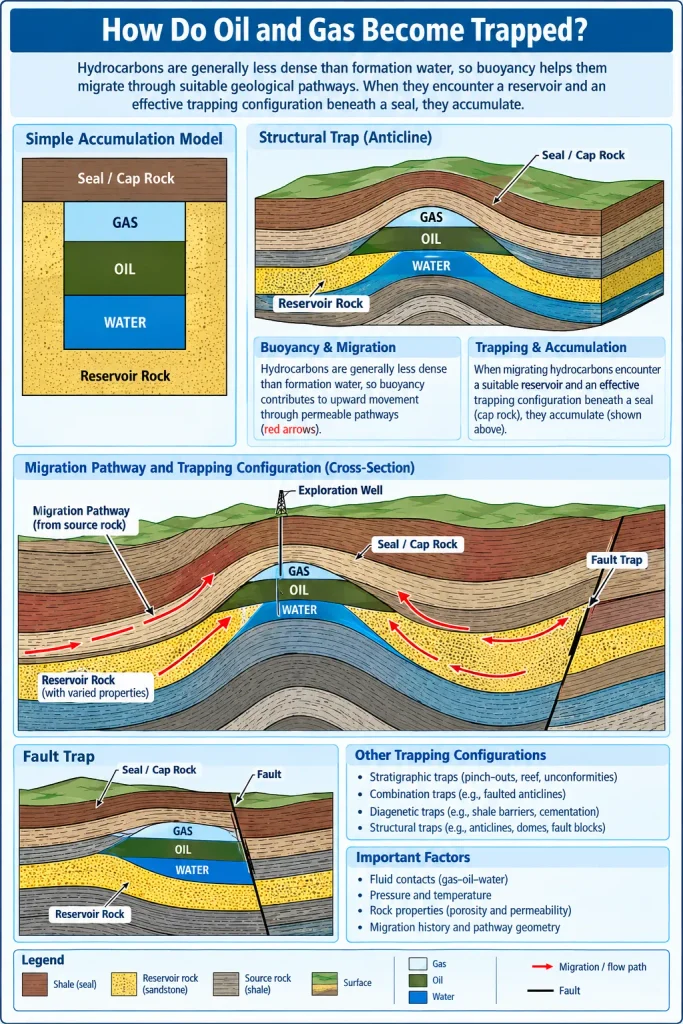
Hydrocarbons are generally less dense than formation water, so buoyancy can contribute to their movement through suitable geological pathways.
When migrating hydrocarbons encounter a suitable reservoir and an effective trapping configuration beneath a seal, they can accumulate.
A basic hydrocarbon reservoir typically holds gas, oil, and water, as illustrated in the diagram.
The actual arrangement is not always this simple. Fluid contacts, pressure, rock properties, migration history, and trap geometry can vary from one field to another. USGS petroleum-system studies show that migration and accumulation can involve complex pathways, faults, and different trapping configurations.
What Types of Traps Can Hold Oil and Gas?
Geologists commonly classify traps into different types.
Structural Traps
These result from deformation of geological layers.
Examples include:
- Anticline traps
- Fault traps
- Fold-related traps
Stratigraphic Traps
These occur because of changes in rock type or depositional geometry.
Examples include:
- Pinch-outs
- Facies changes
- Unconformity-related traps
Combination Traps
Some accumulations involve both structural and stratigraphic controls.
Understanding the trap is important because it helps geologists predict where hydrocarbons might have accumulated.
How Do Geologists Search for Oil and Gas?
Geologists cannot see thousands of metres beneath the Earth’s surface directly.
Instead, they build a geological model using multiple sources of information.
The exploration process may include:
- Regional geological studies
- Basin analysis
- Surface geological mapping
- Existing well data
- Geochemical information
- Gravity surveys
- Magnetic surveys
- Seismic surveys
- Geological and geophysical interpretation
- Exploration drilling
No single technique provides the complete answer.
To predict whether an underground formation contains viable oil and gas, geoscientists evaluate four key elements: source rock generation, hydrocarbon movement, reservoir storage, and structural traps.
Gravity and Magnetic Surveys
Prior to drilling, teams rely on geophysical tools to study the large-scale underground architecture of a region.
Gravity Surveys
Different rock types have different densities.
Small variations in Earth’s gravitational field can therefore provide information about subsurface geological structures.
Magnetic Surveys
Magnetic measurements can help identify variations in the magnetic properties of subsurface rocks.
These methods generally do not directly locate an oil pool.
Instead, they help geoscientists understand the geological framework and identify features that may be relevant to further exploration.
Seismic Exploration: Looking Beneath the Surface
One of the most important tools in modern petroleum exploration is seismic surveying.
It works by sending energy waves down into the earth and analyzing the echoes that bounce back.
A seismic source generates energy.
The energy travels through the subsurface.
When seismic waves encounter boundaries between geological layers with different physical properties, part of the energy can be reflected back.
Sensors record these returning signals.
Specialists then process and analyze this raw data to create clear pictures of underground rock formations.
Offshore exploration relies heavily on seismic data to map rock formations beneath the seabed.
This is where our next article will go deeper into:
How Offshore Seismic Surveys Work
From Seismic Data to an Exploration Prospect
A seismic survey does not simply display a hidden oil reservoir like an X-ray. Instead of looking directly underground, geoscientists study the bounce-back patterns of seismic waves to map subsurface rock layers.
They may look for features such as:
- Anticlines
- Faults
- Stratigraphic changes
- Possible reservoir intervals
- Sealing formations
- Structural closures
The interpretation is combined with information about source rocks, reservoir quality, migration pathways and seals.
A potential target may then be classified as a prospect if the available evidence suggests that it could contain hydrocarbons.
But a prospect is still a geological hypothesis.
An exploration well provides a direct test of the geological target. The resulting well data, rock samples, and fluid evaluations help determine whether the predicted formation contains hydrocarbons.
What Is an Exploration Well?
An exploration well is drilled to determine whether hydrocarbons are present in a previously untested geological target.
When a well is drilled in a brand-new region with no prior history of oil and gas production, it is commonly referred to as a wildcat well.
The drilling process involves much more than simply making a hole in the ground.
A drilling operation may involve:
- Drilling rig
- Drill bit
- Drill string
- Drilling fluid
- Blowout preventer
- Casing
- Cement
- Well-control equipment
- Logging tools
- Geological evaluation
The exact design depends on the well and geological environment.
How Does Drilling Reach the Reservoir?
The drill bit cuts through the formations below the surface.
As drilling progresses, sections of casing are installed and cemented in the well.
Drilling fluid, commonly called drilling mud, circulates through the well during drilling.
It performs several important functions, including:
- Carrying rock cuttings to the surface
- Cooling and lubricating the drill bit
- Helping control formation pressure
- Supporting the wellbore
- Providing information about the formations being drilled
The drilling team continuously monitors well conditions because formation pressure and rock properties can change with depth.
How Do Engineers and Geologists Know What Was Drilled?
Drilling to the target depth is just the first step in the process.
The formation must then be evaluated.
One important technique is well logging.
Logging tools can measure different properties of the formations surrounding the wellbore.
Depending on the logging program, measurements may provide information about:
- Formation resistivity
- Natural radioactivity
- Density
- Neutron response
- Porosity
- Formation boundaries
- Possible fluid-bearing intervals
These measurements help the subsurface team determine whether the drilled formation has characteristics consistent with a hydrocarbon-bearing reservoir.
What Is Coring?
In some wells, engineers and geologists may obtain actual cylindrical pieces of formation called cores.
Core samples can provide direct information about the rock.
They can be examined for properties such as:
- Lithology
- Porosity
- Permeability
- Grain characteristics
- Fluid saturation
- Rock texture
- Geological features
Core data can be particularly valuable because it provides physical samples that can be tested in the laboratory.
What Happens If Oil or Gas Is Found?
Finding oil or gas is only half the battle; the deposit must also be large enough to make commercial extraction worthwhile.
This is an important distinction.
After a discovery, additional work may be required to understand:
- Reservoir size
- Reservoir continuity
- Thickness
- Porosity
- Permeability
- Fluid properties
- Pressure
- Hydrocarbon contacts
- Well productivity
- Estimated recoverable volumes
- Development requirements
- Economic feasibility
This stage is commonly associated with appraisal.
Engineers drill extra wells to map out how far the oil field extends beyond the initial discovery.
Discovery Is Only the Beginning
Imagine a drilling team encounters oil during an exploration well.
That is exciting—but several questions immediately follow:
How large is the accumulation?
How thick is the reservoir?
How good is the reservoir rock?
How much oil or gas can we actually pull out of the ground?
Can wells produce at useful rates?
Can the field be developed safely?
What facilities and pipelines will be required?
Will the project be commercially viable?
These questions demonstrate why petroleum exploration involves geology, geophysics, drilling, reservoir engineering, production engineering, facilities engineering, economics, environmental studies, and many other disciplines.
From Discovery to Field Development
If appraisal data confirms the reserve is viable, the project moves forward into development.
A development project may require:
- Production wells
- Injection wells where applicable
- Wellhead facilities
- Separators
- Pumps
- Compressors
- Water-treatment systems
- Gas-treatment systems
- Storage facilities
- Pipelines
- Offshore platforms or subsea systems
- Onshore processing facilities
- Export infrastructure
The exact facilities depend on the type and location of the field.
This is where the broad discipline of plant engineering becomes increasingly important.
The hydrocarbons must eventually be produced, separated, treated, measured, transported, and prepared for their next stage.
Discover how these activities fit into the wider oil and gas industry in our guide to how oil and gas engineering works, from exploration to refinery. It explains the journey from finding hydrocarbon resources to production, transportation, processing, and refining.
Hydrocarbon Generation to Production Flowchart
The entire process can be simplified as:
Hydrocarbon Lifecycle & E&P Process
From Geological Formation to Commercial ProductionThis is a simplified model. Creating a real petroleum system takes time, involving hydrocarbon creation, fluid movement, structural changes, and final trapping deep underground.
Why Finding Oil Is So Difficult
Looking for petroleum is not simply a matter of drilling deeper.
A successful exploration target requires several geological conditions to work together.
There must be a suitable source of hydrocarbons.
Those hydrocarbons must mature and be generated.
They must have a pathway to migrate.
A suitable reservoir must exist.
A seal must prevent further escape.
A trap must provide a place for accumulation.
Crucially, these geological factors must come together at the right place and time.
That is why exploration teams combine geology, geophysics, geochemistry, seismic interpretation, drilling data and engineering analysis rather than relying on a single indicator.
What Comes Next?
Once hydrocarbons have been discovered and the field is developed, the story does not end.
Produced fluids still have to be handled at the surface.
Oil, gas, and water may need to be separated.
Gas may require treatment.
Water may require processing.
Oil may require stabilization or other treatment before transportation.
The produced hydrocarbons then enter the wider midstream and downstream systems.
Crude oil may eventually travel by pipeline or tanker to a refinery, where it is processed into different petroleum products.
That takes us from the story of finding hydrocarbons to the next major part of the oil and gas industry:
How does a refinery turn crude oil into useful products?
Frequently Asked Questions (FAQs)
1. What is the geological timeline required to generate petroleum?
Oil and natural gas generally form over millions of years through the burial and thermal maturation of organic matter in suitable geological conditions. The time required depends on factors such as the type of organic material, burial history, temperature, and geological conditions.
2. Do seismic surveys guarantee that oil or gas is actually underground?
No. Seismic surveys help geoscientists interpret underground rock layers and identify potential hydrocarbon traps, but they cannot independently confirm that a formation contains oil or gas. An exploration well is generally needed to test the target, while well logs, rock samples, and fluid evaluation provide further evidence.
3. Why Do Certain Rocks Produce Oil and Gas While Others Just Hold Them?
Source rocks and reservoir rocks perform different jobs in a petroleum system. A source rock contains organic material that can produce oil and natural gas after suitable burial and heating. A reservoir rock, by contrast, has pore spaces that can hold these fluids and, where the pores are sufficiently connected, allow them to flow. In some petroleum systems, hydrocarbons move from the source rock into a separate reservoir rock.
4. From Discovery to Production: Why Some Reserves Stay in the Ground?
A discovery does not automatically mean that a field can be developed commercially. Further studies are required to calculate the deposit size, rock quality, and total extractable volume. Evaluating production potential, upfront costs, and profitability helps companies decide whether developing the field is a smart investment.
5. What Steps Follow a Successful Exploration Discovery?
When an exploration well encounters hydrocarbons, the next task is to determine whether the accumulation can support a viable project. The exploration team may collect additional geological and reservoir data, drill appraisal wells, assess fluid properties, and estimate potentially recoverable volumes. Engineers then evaluate production options, required facilities, environmental considerations, costs, and commercial risks before a decision is made about field development.
Conclusion
The journey from ancient organic matter to a producing oil or gas field takes millions of years—but discovering that accumulation requires modern science, technology, and engineering.
First, geologists study regional rock formations to identify areas that may contain a working petroleum system. Geophysical surveys and seismic interpretation help refine potential targets, while exploration wells test whether hydrocarbons are actually present. Geophysicists then use gravity, magnetic and seismic tools to visualize underground layers. Finally, to test these findings, drilling teams sink exploratory wells to see if the predictions hold true.
Once hydrocarbons are found, additional testing is necessary to measure the volume, flow capacity, and overall commercial value of the discovery.
Only after this work can a project progress toward field development and production.
So the next time you see an oil well, offshore platform, or refinery, remember that the story began much deeper in Earth’s geological history—with organic matter, sediment, heat, pressure, rocks, and millions of years of change.