
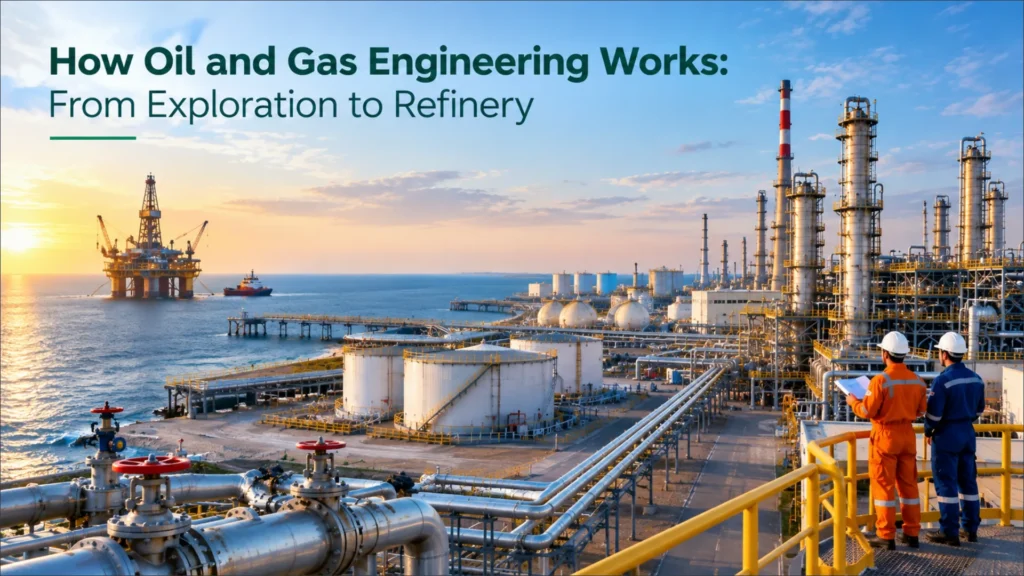
Oil and gas engineering is a vast field that connects geology, drilling, production, process engineering, mechanical engineering, piping, instrumentation, electrical engineering, maintenance, and many other disciplines.
But where does the journey actually begin?
Before crude oil reaches a refinery and becomes fuels or other useful products, engineers and scientists must first identify potential hydrocarbon resources, evaluate them, drill wells, produce the fluids, transport them, and finally process them in refineries and gas-processing facilities.
In this article, we will take a simple journey through the oil and gas industry, starting with exploration and ending with refining and processing.
In simple words: oil and gas engineering is about finding hydrocarbons, bringing them safely to the surface, transporting them, processing them, and converting them into useful products.
Table of Contents
What Is Oil and Gas Engineering?
Oil and gas engineering is a multidisciplinary area of engineering concerned with the exploration, production, transportation, processing, and refining of hydrocarbons.
It involves many different engineering disciplines working together.
For example:
| Discipline / Role | Key Focus / Responsibility |
|---|---|
| Geologists & Geophysicists | Investigate underground formations and identify possible hydrocarbon-bearing structures. |
| Reservoir Engineers | Study the behavior of fluids inside underground reservoirs. |
| Drilling Engineers | Plan and execute well drilling operations. |
| Production Engineers | Optimize hydrocarbon production from wells. |
| Process Engineers | Design and operate facilities that separate and process oil and gas. |
| Mechanical Engineers | Work with equipment such as pumps, compressors, pressure vessels, and heat exchangers. |
| Piping Engineers | Design piping systems for transporting fluids throughout a facility. |
| Instrumentation Engineers | Manage measurement, automation, and control systems. |
| Electrical Engineers | Provide electrical power and distribution systems required for safe and reliable plant operation. |
This makes oil and gas engineering much broader than a single engineering discipline.
The Oil and Gas Journey: From Exploration to Refinery
The oil and gas industry can be broadly understood through three major sectors:
1. Upstream
Exploration and production of oil and gas.
2. Midstream
Transportation, storage, and handling of hydrocarbons.
3. Downstream
Refining, gas processing, petrochemicals, and distribution of products.
Let’s look at each stage.
Upstream: Finding Oil and Gas
The upstream sector is where the journey begins.
Before engineers can produce oil or gas, they first need to understand where hydrocarbon accumulations may exist beneath the Earth’s surface.
Exploration involves geology, geophysics, geochemistry, seismic surveys, data interpretation, and eventually exploratory drilling.
The objective is not simply to “find oil.” The exploration team needs to understand whether the geological conditions are suitable for a petroleum accumulation and whether further evaluation is justified.
How Do Engineers Search for Oil?
Exploration normally involves several stages.
Geological Studies
Geologists study the history and structure of an area.
They investigate:
- Rock types
- Sedimentary basins
- Geological structures
- Faults and folds
- Source rocks
- Reservoir rocks
- Seal rocks
- Possible hydrocarbon traps
The purpose is to build an understanding of the petroleum system and identify areas where hydrocarbons may have accumulated.
Geophysical Surveys
Geophysical techniques provide information about the subsurface without immediately drilling a well.
Common techniques include:
- Seismic surveys
- Gravity surveys
- Magnetic surveys
- Other geophysical measurements
Among these, seismic surveys are particularly important for understanding subsurface structures.
Offshore Oil Exploration: Looking Beneath the Seabed
Offshore exploration presents an additional challenge.
Instead of investigating land, engineers and scientists must study geological formations beneath the seabed, sometimes beneath several kilometres of water and rock.
This requires specialized vessels, equipment, software, and drilling systems.
Seismic Surveys: Listening to the Earth
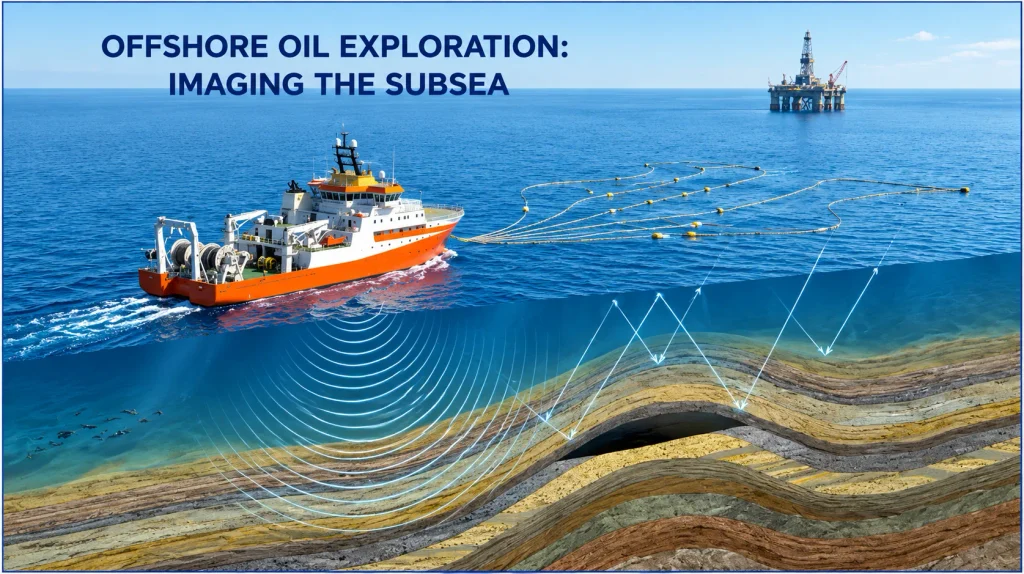
One of the important tools used in offshore exploration is seismic surveying.
A seismic vessel moves along planned survey lines while towing equipment behind the vessel.
Controlled acoustic energy is introduced into the water. The resulting seismic waves travel into the seabed and are reflected by different geological layers.
Sensors called hydrophones, commonly arranged in long streamers, record the returning signals.
Specialized computer systems then process these measurements to create images and models of the subsurface.
These models can help exploration teams identify geological structures that may have the characteristics of hydrocarbon traps.
A simple way to understand it
Think of seismic surveying as a type of underground imaging technique.
The equipment sends controlled energy into the Earth and records the returning signals. Engineers and geoscientists then interpret those signals to understand what may be beneath the surface.
Geochemical and Geological Evaluation
Seismic information is only one part of exploration.
Scientists may also study rock samples, sediments, fossils, and geochemical information to understand the geological history of an area.
This can help answer questions such as:
- When were the rocks formed?
- Could organic material have accumulated?
- Could hydrocarbons have been generated?
- Are suitable reservoir rocks present?
- Is there a sealing layer?
- Could hydrocarbons have been trapped?
These questions are important when evaluating a potential prospect.
Exploratory Drilling: Testing the Geological Model
After extensive exploration work, a company may decide to drill an exploration well, sometimes referred to as a wildcat well when it is drilled in an area where commercial production has not yet been established.
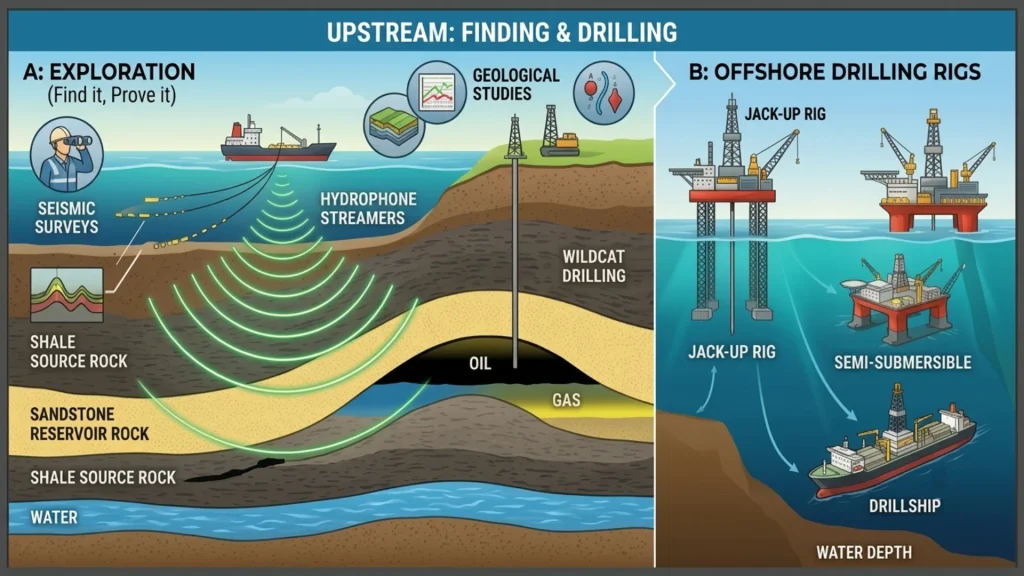
Drilling provides information that cannot be obtained from surface or seismic data alone.
During drilling, engineers and geoscientists may collect information from:
- Drill cuttings
- Well logs
- Formation pressure measurements
- Core samples
- Fluid samples
- Drilling parameters
Modern drilling systems can also provide important formation information while the well is being drilled.
What happens if hydrocarbons are found?
A discovery of oil or gas does not automatically mean that a commercial field has been established.
Further appraisal and evaluation may be required to understand:
- Reservoir size
- Fluid properties
- Pressure
- Rock properties
- Production potential
- Recoverable volumes
- Development requirements
Only after detailed evaluation can the project move toward development and production.
Offshore Drilling Rigs
Different types of offshore drilling units are used depending on factors such as water depth, environmental conditions, well requirements, mobility, and project economics.
Three commonly discussed types are:
| Rig Type | Typical Application | Basic Principle |
|---|---|---|
| Jack-up rig | Shallow to relatively moderate water depths (up to ~120–150 m) | Retractable legs are lowered to the seabed and the working deck is raised above the water. |
| Semi-submersible | Deeper water (up to ~3,000+ m) and harsh marine environments | Floating structure supported by submerged pontoons and columns for stability in high waves. |
| Drillship | Deep and ultra-deep water (up to ~3,600+ m) | Ship-shaped drilling vessel equipped with drilling equipment and dynamic positioning (DP) systems. |
The actual operating depth of a particular rig depends on its design and specification, so these categories should not be treated as fixed depth limits.
The Role of Safety and Environmental Protection
Oil and gas exploration and production involve significant technical and environmental risks.
For offshore seismic operations, for example, project teams may have environmental requirements related to marine life.
Depending on the location, project, and applicable regulations, measures can include:
- Marine mammal observation
- Passive acoustic monitoring
- Controlled startup procedures
- Defined exclusion or monitoring zones
- Operational shutdown or modification procedures when required
The exact requirements vary according to the project, environmental assessment, regulations, permits, and operating procedures.
Safety and environmental protection are therefore not separate from engineering—they are an important part of the engineering process.
From the Well to Production
Once an oil or gas field is evaluated and approved for development, production facilities are designed and constructed.
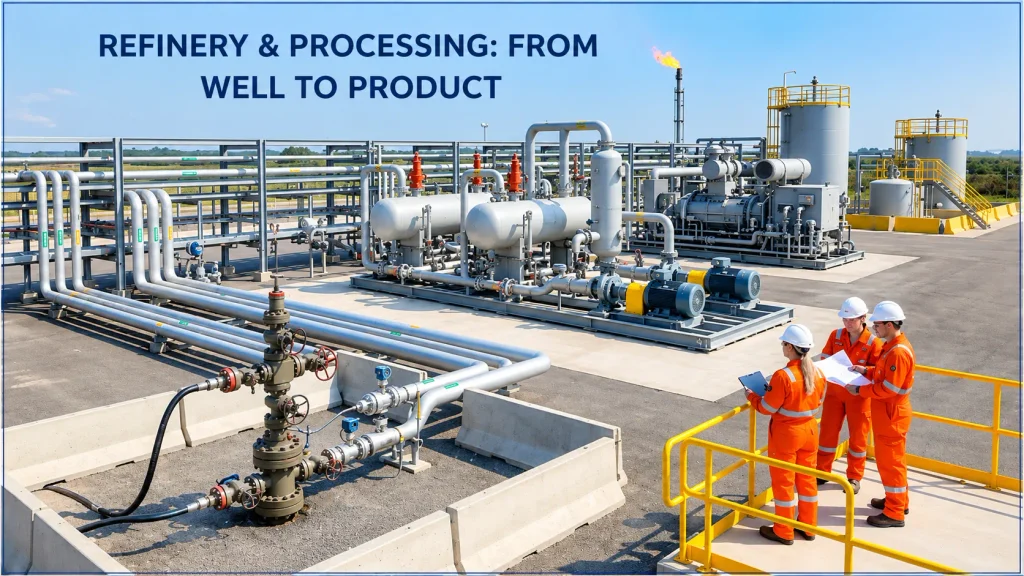
The produced fluid from a well is often not simply “pure oil.”
It may contain a combination of:
- Crude oil
- Natural gas
- Water
- Sand or other solids
- Dissolved gases
- Other contaminants
Production facilities therefore use equipment to separate, treat, measure, and condition the produced fluids.
Depending on the field, facilities may include:
- Separators
- Heaters
- Pumps
- Compressors
- Dehydration systems
- Water-treatment equipment
- Storage tanks
- Flare systems
- Metering systems
This is where many different plant-engineering disciplines come together.
Midstream: Moving Oil and Gas
After production, hydrocarbons need to be transported from producing areas to processing facilities, refineries, export terminals, storage facilities, or other destinations.
This is broadly associated with the midstream sector.
Transportation can involve:
- Pipelines
- Tankers
- Storage terminals
- Gathering systems
- Gas transmission systems
- Processing and compression facilities
Pipelines are particularly important because they allow large quantities of fluids to be transported over long distances.
The design of these systems involves many engineering considerations, including:
- Flow rate
- Pressure
- Temperature
- Fluid properties
- Materials
- Corrosion
- Hydraulic requirements
- Safety
- Mechanical integrity
This area will become an important topic for future articles on Know Plant Engineering.
Downstream: Turning Crude Oil into Useful Products
The downstream sector includes refining and the production and distribution of petroleum products.
A refinery does much more than simply “heat crude oil.”
The crude oil first needs to be properly evaluated and prepared for processing.
How Is Crude Oil Evaluated?
No two crude oils are exactly the same.
Crude oils can differ significantly in properties such as:
- Density
- API gravity
- Viscosity
- Sulfur content
- Wax content
- Acidity
- Metals
- Distillation characteristics
- Product yield
These properties influence how the crude oil behaves during processing and what refinery configuration may be suitable.
API Gravity
API gravity is commonly used by the petroleum industry to describe the density of crude oil and petroleum liquids relative to water.
In general, a higher API gravity indicates a lighter crude, while a lower API gravity indicates a heavier crude.
However, API gravity alone does not tell us everything about crude oil quality or refinery value. Other properties such as sulfur content, acidity, contaminants, and product yield are also important.
Atmospheric Distillation: One of the First Major Refinery Steps
Most crude oil refineries begin crude processing with atmospheric distillation after appropriate pretreatment, including desalting.
The basic idea is simple:
Crude oil is heated and separated into fractions according to their boiling ranges.
The atmospheric distillation unit produces different streams or fractions that can be further processed.
Depending on the refinery, these may include:
- Refinery gases
- Naphtha
- Kerosene-range material
- Gas oils
- Atmospheric residue
The heavier atmospheric residue can undergo additional processing.
What Happens to the Heavier Fractions?
A refinery can use different processing units depending on its configuration and the desired products.
Heavy fractions may be processed using technologies such as:
- Vacuum distillation
- Fluid catalytic cracking
- Hydrocracking
- Coking
- Visbreaking
- Asphalt processing
Other refinery units are used to improve product quality and remove unwanted components.
For example, hydrotreating can be used to reduce sulfur and other contaminants from certain refinery streams.
This is one reason why refineries are highly integrated process plants rather than simple distillation facilities.
From Refinery to Final Products
After crude oil is separated and processed, refinery streams can be converted into products used throughout modern society.
Depending on the refinery configuration, products may include:
- Gasoline
- Diesel
- Jet fuel
- LPG
- Naphtha
- Fuel oils
- Lubricant base stocks
- Asphalt/bitumen
- Petrochemical feedstocks
The exact products and quantities depend on the crude oil characteristics and refinery configuration.
The Complete Oil and Gas Journey
We can now simplify the entire journey into one flow:
Exploration → Geological Evaluation → Seismic Surveys → Exploratory Drilling → Appraisal → Field Development → Production → Processing → Transportation → Refining → Final Products
This journey involves hundreds of engineering activities and many specialized disciplines.
That is what makes the oil and gas industry such a broad engineering field.
The Main Engineering Careers in Oil and Gas
Because the industry is multidisciplinary, there are many career paths.
| Career / Role | Primary Responsibility & Key Focus |
|---|---|
| Reservoir Engineer | Studies reservoir rock and fluid behavior to estimate reserves and help optimize hydrocarbon recovery. |
| Drilling Engineer | Plans and supports drilling operations, including well design, drilling equipment, and well-control considerations. |
| Production Engineer | Works to optimize production from wells and the equipment connecting the reservoir to surface facilities. |
| Process Engineer | Works with process systems used to separate, treat, convert, and process hydrocarbons. |
| Mechanical Engineer | Works with mechanical equipment such as pumps, compressors, pressure vessels, heat exchangers, and other plant equipment. |
| Piping Engineer | Designs piping systems used to safely transport fluids throughout process facilities. |
| Instrumentation & Control Engineer | Works with instruments, control systems, measurement, alarms, and automation used to operate plants safely and efficiently. |
| Electrical Engineer | Designs and supports electrical systems required for power generation, distribution, motors, lighting, protection, and other plant services. |
These roles are closely connected. A large oil and gas project requires different engineering disciplines to work together.
What Does the Oil and Gas Lifecycle Really Look Like?
The oil and gas industry can be viewed as a continuous engineering chain:
| Lifecycle Stage | Engineering Activity & Description |
|---|---|
| Find it | Exploration and geological studies identify potential hydrocarbon resources. |
| Prove it | Exploratory drilling and evaluation determine whether hydrocarbons are present and help characterize the discovery. |
| Develop it | Engineers design wells, production facilities, pipelines, and supporting infrastructure. |
| Produce it | Oil and gas are brought safely to the surface and processed. |
| Transport it | Pipelines, vessels, terminals, and other systems move hydrocarbons to their destinations. |
| Process it | Gas plants and refineries convert raw hydrocarbons into useful streams and products. |
| Maintain it | Equipment and facilities require inspection, maintenance, reliability management, and continuous monitoring throughout their operating life. |
| Decommission it | At the end of a field or facility’s useful life, wells and facilities are safely decommissioned according to applicable requirements and the site may be restored or repurposed. |
Conclusion
Oil and gas engineering is much bigger than drilling wells or operating refineries.
It is a combination of geology, engineering, process technology, equipment, piping, control systems, electrical systems, safety, maintenance, reliability, and operations.
The journey starts deep beneath the Earth—or beneath the seabed—and eventually leads to processing plants, refineries, pipelines, terminals, and products used around the world.
At Know Plant Engineering, we will explore these subjects step by step.
In future articles, we will go deeper into individual areas such as upstream engineering, process engineering, refinery units, piping systems, equipment, process safety, instrumentation, maintenance, reliability, and plant design.